
“Wise men speak because they have something to say; Fools because they have to say something.”
Plato
Communication As A Mental Skill
NOTE: If you’re not part of a traditional team sport and therefore think that an article about communication doesn’t apply to you then think again. “Team” by our definition basically just means a group of people working together. So if you’re an individual sport athlete then “your team” is probably your family, your coach(es) basically anyone in your life with whom you have a relationship. Ideally, one of these helpers is a qualified performance or sport psychologist (hopefully one of us 😊). Of course, for athletes of traditional team sports all these “support” people also apply. But the overall number of personnel in your “team” is probably larger.
Let’s Start With A Question
Is communication really a mental skill or is it more of a life skill? Well, to be honest, most psychological skills are life skills. Some are obvious whilst others are in disguise with a fake mustache and a wig! Let’s take motivation as an example. Yes, motivation is hugely valuable in sport and performance but really it’s useful for everyone in every situation. The kind of commitment that high-performing athletes have to get up at 5 am and train is not that different from plumbers who get up at a similar time in order to earn an honest income.
Simply put, as human beings our mental strengths and weaknesses spill into everything we do. Although at Condor Performance we tend to assist athletes, coaches and performers improve mental areas such as communication mainly for performance enhancement in most cases it benefits them well beyond their chosen domain. This is a nice side effect of working with someone trained in both general psychology as well as performance psychology.
What Is Communication? What Is It Not?
The Cambridge Dictionary defines communication as “the activity of expressing or exchanging information, feelings, etc.”
Some psychologists like to include, in the definition of communication, “communicating” with oneself. We disagree with this. “Communicating” with oneself should fall under thinking and self-talk. The word itself in English derives from the Latin communicare meaning “to share”. So for us, communication as a mental skill needs to involve at least two people.
So how do we share with others then?
Basically, in either a non-verbal or verbal way. Non-verbal includes body language, facial expressions, and tone of voice. Verbal includes the actual words.
Then, of course, there is both the production of these and the receiving of them too. By production I mean you are producing the stimulus. By receiving, someone else is.
How Well Do You Communicate Now?
One way to answer this is by asking others. Or you could complete one of our MTQs all of which attempt to measure communication. However, arguably the most objective way of measuring this critical mental skill is by recording yourself. When watching yourself back turn the volume down to analyse your body language, for example. How focused are you in the footage when someone else is doing the communicating? For example, when a coach or captain is going over tactics? And one of the very best questions you could ever ask yourself.
How could I have done that better?
Use A 2 x 2 Matrix
A 2 x 2 matrix is just a small table with two rows and two columns. To improve your communication as a mental skill create one like the one below somewhere.
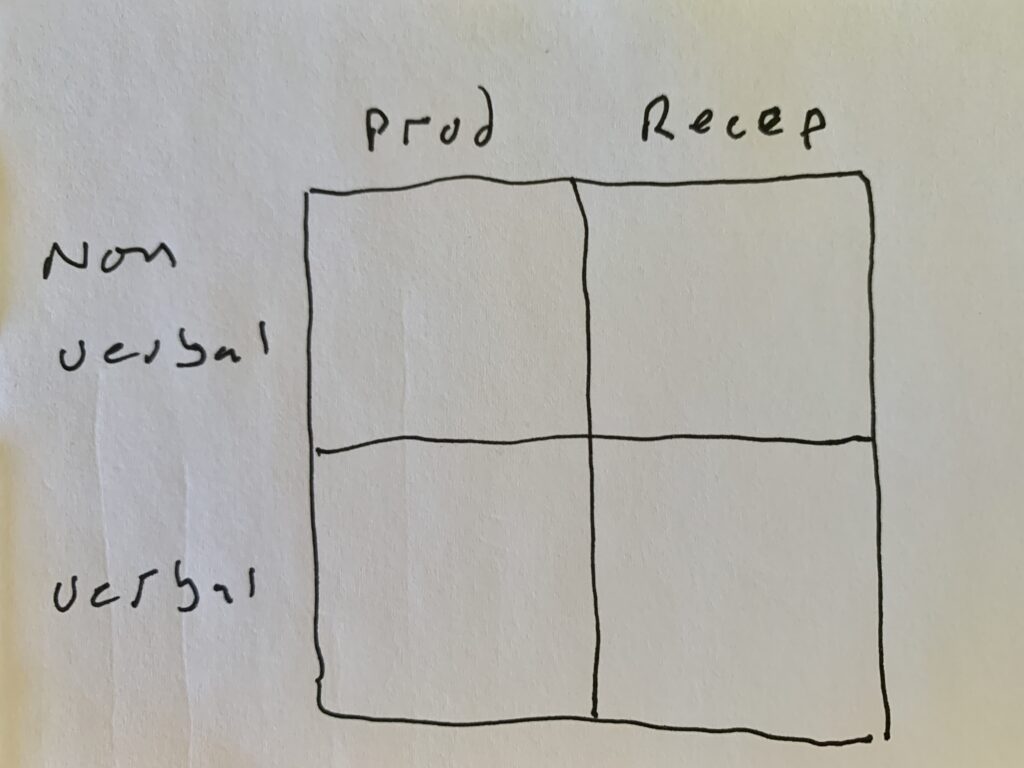
As you can see the four main types of communication each have their own cell. 1) Non-verbal production, 2) Verbal production, 3) Non-verbal reception and 4) Verbal reception.
Try to spend 5 minutes a week trying to improve each cell of the Matrix. For example, for non-verbal production, you might practice looking confident in front of a mirror. Remember, you don’t have to be confident to portray confidence to others. Read much more on this concept here.
For the Verbal Productive
And as always, if you need a hand, just fill out our Contact Us form and one of the crew will get back to you with detailed info on our 1-on-1 services.

Great article Chris. I particularly appreciate the opening note about how we define a “team”. No one goes the distance on their own. There’s always someone, whether that be a family member, friend or coach. If anything we benefit from acknowledging the need to have a higher quality connection with everyone around us. Non-verbal communication sings out to me as a wonderful place for improvement. It’s a good place to start on developing our actions coming before our emotion. It’s also a great way to understand the messages we are sending to our team. Recording ourselves is a great suggestion and like you said, one of the few ways to remain objective in reviewing our body language.